
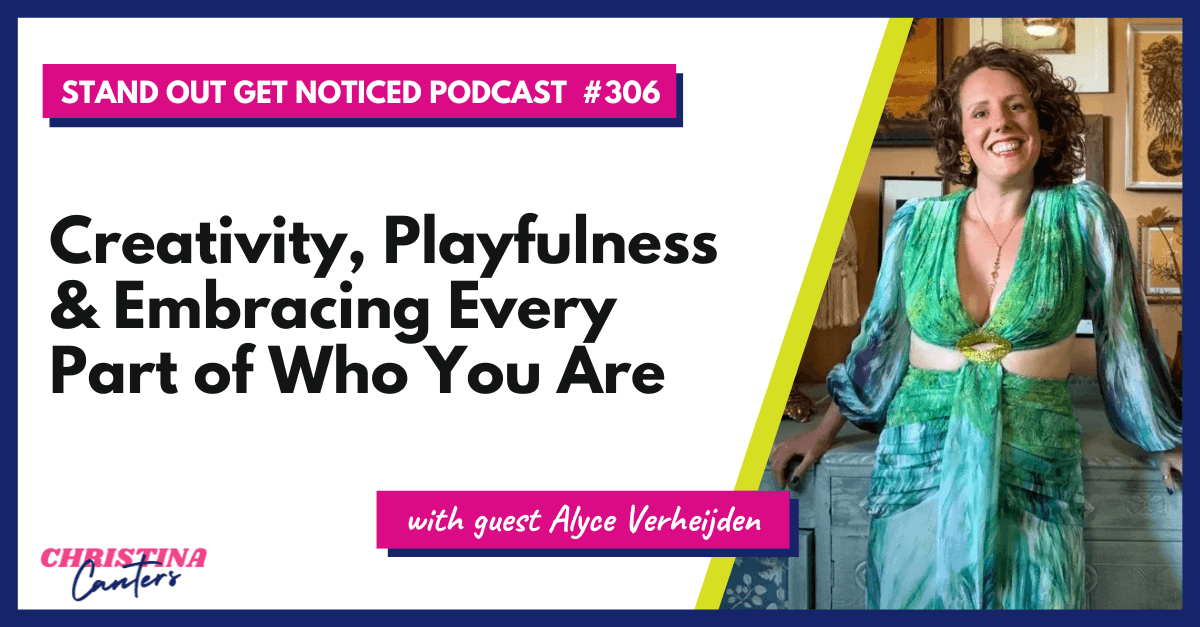
Are you afraid of bringing creativity and playfulness to your ‘serious’ professional life?
Maybe you think you’re “not very creative”? Or are you afraid of showing your creative self? I hear you! In this episode I am so excited to introduce you to author, illustrator and all-around creative powerhouse (and my good friend) Alyce Verheijden. She and I are like two peas in a pod – we both run professional services businesses (I am a corporate communication skills trainer, and run a podcast development agency, and Alyce is the General Manager of a fire safety engineering company), AND we both have very creative ‘other sides’ to our lives too.
Alyce recently finished and published her debut book, The Patchwork Girl, a visual poem about learning to accept all the different parts you – and not ‘editing’ or ‘streamlining’ yourself to be more palatable to others.
The Patchwork Girl began during COVID lockdown, when Alyce started piecing together an actual patchwork quilt, alongside a self-development course that got her thinking seriously about intuition and creative expression for the first time. The idea for a book arrived quickly. Finishing it took six years, an intuitive coach, and a fair bit of wrestling with her own perfectionism.
In this episode you will discover:
- The book is a metaphor for refusing to shrink yourself. Alyce describes the Patchwork Girl as a stand-in for the pressure to become “streamlined,” to smooth over the parts of your personality that don’t fit neatly together. The book argues for keeping every piece rather than editing yourself down to something more palatable.
- Naming your fear about creative exposure helps you move through it. Alyce was super nervous about publishing something so personal, and about asking people to pay for it. Talking that fear through let her separate the actual risk from the story she was telling herself about it.
- Accountability got the book finished, not motivation. Alyce credits working with an intuitive coach, someone who could see the project’s importance even when she was minimising it as “a cute little side project,” as the turning point. A scheduled launch party, booked before the book was actually done, became the deadline that forced the final push.
- Perfectionism nearly stalled the whole thing. With all six characters drawn and the story mapped out, Alyce got stuck comparing her earlier illustrations (from six years ago) with her more recent, more skilled work. Reframing the stylistic shift as part of the story’s own growth arc, rather than a flaw to fix, is what let her finish.
- Creativity is a far bigger category than most people give it credit for. Cooking, arranging a room, doodling, gardening, even the way you approach a client problem at work: Alyce and I explore how creativity gets narrowed down to painting and drawing, when it’s really any process of building something from a vision.
- Keeping your creative life “secret” isn’t unusual, and it isn’t failure. Alyce spent years unable to explain what her book was even about, worried it would undercut how seriously she was taken as a business owner. She and Christina both note that creativity often needs its own protected space before it’s ready to be public.
Why Creativity and Playfulness Matter For Professionals and Leaders
There’s a persistent idea that creative and “serious” professional identities have to be kept apart, that showing your playful, artistic, or whimsical side undermines how seriously you’re taken at work. Alyce and I push back on that directly, drawing on our shared background in architecture, a field that promises creativity but often delivers years of technical, administrative grind instead.
What comes through clearly in this conversation is that creativity isn’t a hobby bolted onto a career. It shows up in how you solve a client problem, how you frame a proposal, how you approach a stuck moment on a project. For leaders and professionals who’ve quietly shelved their creative interests to seem more credible, this episode shows you that the two aren’t actually in competition, and that reclaiming some playfulness might make you sharper at the “serious” parts of your work, not less capable at them 🙂
Connect with Alyce:
- Alyce’s website: averh.com.au
- Buy a copy of The Patchwork Girl: averh.com.au/the-patchwork-girl
- Connect with Alyce on Instagram: https://www.instagram.com/the.patchwork.girl
Related episodes:
- How I’m Still Learning to Express Myself Fully [Episode 286]
- Why You Need To Be Creative in Business [Episode 35]
- George Siosi Samuels on Creativity, Storytelling and Flow [Episode 6]
Click to read the full episode transcript
[TEASER — cold open]
Alyce Verheijden
There is a smaller kind of triangle-shaped hammock in the front yard, and what’s really funny about that one is adults think it’s like a shade cloth, or something for the garden. Two kids came to my house and straight away they’re in it — they can tell it’s a hammock. And I’m like, see — kids haven’t lost touch with creativity and playfulness. They are interpreting everything as play and creation.
Christina Canters
Hi everyone, I’m Christina Canters, and I’m really excited to be here with Alyce Verheijden, who is a fabulous author, illustrator and all-around powerhouse creative. And you’ve just finished and published your very first book, The Patchwork Girl.
Alyce Verheijden
Yes.
Christina Canters
Here we go. And today we’re going to have a conversation around this book and what inspired it, and I just want to learn all about it and get it out there into the world.
Alyce Verheijden
Amazing, thank you.
Christina Canters
So tell me, The Patchwork Girl — give us a brief synopsis. How would you describe this book?
Alyce Verheijden
This book, The Patchwork Girl, is basically a metaphor. I used a clothing-based metaphor because I love clothing and fashion and sewing. And it’s a metaphor about belonging in the world that you find yourself in. So she’s a patchwork girl, but she lives in a world that is not — like, you know, as you grow up, you’re meant to become streamlined and sophisticated. But she’s like, but I’m a patchwork. I love every part of me. I love every different personality, trait and interest. And she doesn’t want to let go or shed any parts of herself. But she increasingly doesn’t feel like she belongs.
Christina Canters
Spoiler alert — is the Patchwork Girl you?
Alyce Verheijden
How did you guess? Yes, it is. It is a story. My dad actually called it a visual poem, and I think that’s actually a really great way of describing it. It’s a visual poem and metaphor of my own growth and learning who I really am, and exploring facets of myself, and then feeling brave enough to show up in the world with all those — as a multifaceted human — even through fearing that I might be judged by certain people for being too whimsical, or too serious, or too bossy, or too sexy. All those things that classically women worry about.
Christina Canters
It’s funny, because you and I — I kind of see us as partners in crime, in terms of, oh, we can be successful mainstream professionals and also be creative and fun and groovy at the same time. And those two things are not mutually exclusive.
Alyce Verheijden
Yeah, a hundred percent, and I love that. It’s really interesting — I was reflecting recently, with having this book and presenting on social media as this creative artist person, that a lot of people might not know I actually run an engineering company. So there’s this whole juxtaposition there, which I like. And that’s kind of part of what the book is about too — I don’t necessarily share too much about the creative things, because I’m the boss and I want them to take me seriously. But at the same time, sometimes I pretend to creative people — like, oh yeah, what do you do? Oh, I write books.
Christina Canters
So tell me about the inspiration behind the book — because at one point this was just an idea, and then you put it into action. I want to hear about the inspiration behind the book.
Alyce Verheijden
All right. So the original idea came to me — it was actually when we were locked down in COVID, and we couldn’t go out and do all the things we normally did. I started making a patchwork quilt, because I’d sewn before, since I was a child, but not patchworking, and I wanted to do a huge one — that takes quite a long time, cutting and piecing it together, and I’d never had time for it until then. Simultaneously, I also started a self-development journey — I studied William Whitecloud’s course called Natural Success. It’s his kind of business, but it was called Create Your Destiny, and it’s about teaching a process around getting in touch with your intuition. That changed how I approach things. Through that too, I realised how significant creativity is to me, and creative expression. I’d always tried to do the right thing — university, business, the traditional career path. So it was the beginning of my questioning of, what do I really care about, what do I want to spend my life on? Whilst I was literally also sewing a quilt, I’m like, oh, I’m a patchwork girl — my whole life is a quilt. Some people think that’s a beautiful thing, some people think it’s ugly. But a patchwork quilt always has a structure, a pattern, a purpose. There’s design — it’s not a chaotic mess. And I’d often thought people saw me as a chaotic mess, because I had so many interests. I guess the actual sewing gave me that concept. And I think I always saw it would be a book, but I didn’t believe I’d actually finish the thing at that time — that was six years ago.
Christina Canters
What do you mean, you didn’t think you’d finish the thing?
Alyce Verheijden
Well, it’s a lot of work to make a book. I also had a lot of self-consciousness about — my drawing has improved a lot in six years, as you can imagine — I’m like, I don’t think I’m a writer, I hated reading and spelling in school. Here we are, and it’s done.
Christina Canters
So how did you get started — what was the starting sort of planning process?
Alyce Verheijden
It’s been pretty intuitive, actually. I started drawing — I think the first part I drew was the part that sets up the world, like, imagine a world where your clothing expresses who you are. I drew that scene, and I was really focusing on that feeling I had of people in my life seeming worried about me, because I hadn’t picked a clear path yet. I was very sure of that feeling, but I didn’t know how to resolve it in the story. And, reflecting back, I realise that’s because I still had to live and learn and unpack all of these things for myself. So whilst I knew the metaphor, I didn’t embody it yet.
Christina Canters
Yeah, you didn’t have the learnings yet to actually come full circle and finish it.
Alyce Verheijden
Yeah.
Christina Canters
So did you learn those things in order to then complete the book?
Alyce Verheijden
Yeah, well, actually, to continue on — that is how I created the book. There’s basically six archetypal characters through the pages, which were things I learned that revealed something about me that I thought was unacceptable.
Christina Canters
Okay.
Alyce Verheijden
So the first character — this really dropped in, this is probably the first character that dropped in for me — she’s called Rava. And she’s very — she represents anger. She comes out as anger, like fire and aggression. I was feeling — I noticed I had a situation going on in my life I was really angry about. I was like, I’m not allowed to be angry about this, I kept trying to push it down, which is one problem. But then I was like, hang on, this anger is pointing out something to me — there’s a problem I need to solve, a situation I’m not happy with, a person I need to remove from my life and my space and my environment. And that’s confronting. So I’m like, oh, the anger is actually here to help me see my boundary and take action on it. That’s what this character ends up yelling at the Patchwork Girl — you’re not saying no, you’re overriding that in yourself. So I learned that lesson in my life. Because I was working on this book — it’s almost like a journaling, creative process in a way — and working on it, I was like, oh, this is like a whole character, and it’s fun to me to personify things. What would this angry, rageful woman look like if she was just allowed to exist in her full form? That’s kind of what I ended up drawing, and then crafting words around.
Christina Canters
Well, that’s a therapy technique, actually — personifying your emotions, like your anger or your sadness, and being able to separate yourself from it, so it’s not “I am the anger” — the anger is just one part of me, and I can talk to the anger, treat it as something separate to me, which makes it much easier to deal with.
Alyce Verheijden
Yeah, which is really cool. And I’ve since learned this after doing the book, because people are like, ah, that’s a process — I’m like, yeah, I guess. And I love that too, because it points out that I did really create this book very intuitively, just through processing and interpreting my experiences of my life.
Christina Canters
Do you have a favourite character in the book?
Alyce Verheijden
Yes.
Christina Canters
Can you share her with us?
Alyce Verheijden
Uh-huh. So, okay, here we go — straight to the middle. This is my favourite character. Her name is Mycele, and she’s like a trickster character — this playful, jiggly kind of thing.
Christina Canters
Okay, what does it say — can you read out that page?
Alyce Verheijden
It says — well, this is how she emerges — it says, “Oh good, you’re unstitched enough to play now.” She emerges to the Patchwork Girl when she’s let go of some things. Mycele represents playfulness. To me, playfulness is such an important part of life, and it’s something that’s so often suppressed, judged as being immature, or like you’re not serious. All these thoughts hold that playfulness down. So this character basically bounces into the room and she’s like, let’s play — let go of all those extra things you’re still holding onto. That’s what she’s reminding us of. See — her pockets are full of glitter and witch’s spells, you know.
Christina Canters
So I know for a fact that there are many people out there who have started books and never finished them, myself included. Tell me, what were some of the challenges that came up for you throughout the book that may have threatened to derail you?
Alyce Verheijden
Great question, and yes, you are so right. It’s interesting — now that I’ve got this, when I talk to people who are writing books, I kind of feel like I want to go and help them finish. Something that’s really helped me is having a coach, someone that you’re accountable to. I mean, of course they’re not going to hassle me — but I mentioned doing the intuitive training with Wynne Whitecloud, and since then I’ve had an intuitive life coach — right now I work with Alex Harvey. The cool thing about working with an intuitive coach is you’re kind of seeing the same vision — she could see how important finishing this book was, and she helped me realise I needed to take it seriously, because I’d been just treating it as a cute little side project I talk about occasionally. So having that accountability of someone else seeing the vision, and being like, this is really important — and then me also saying it was important — I knew I had to keep working on it. But towards the end, I got a bit stuck — I had all the characters, I knew the full story, but then my perfectionism kicked in — I was like, I don’t know if it’s going to be perfect enough, I don’t know if my drawing is good enough. Working with Alex helped me just accept that the earlier illustrations are a different style to the later illustrations in the book. I was judging that as not being okay, but I actually learned to see that becomes part of the story too, because it’s a story of a journey of growing and changing.
Christina Canters
Did that perfectionism become a character?
Alyce Verheijden
No, not really, actually.
Christina Canters
Maybe the next book, then.
Alyce Verheijden
Yeah, maybe — it’s more like an anti-character, like a villain.
Christina Canters
Perhaps, perhaps. So, having someone to keep you accountable —
Alyce Verheijden
Yes. I then ended up setting a deadline to finish putting the book together, and just had to be like, this is when it will be done. I was actually away when I finished it, so I had fewer other things going on in my life — that’s when I gave myself the deadline. And I had a party to celebrate finishing putting the book together.
Christina Canters
Did you schedule that party before it was done?
Alyce Verheijden
Yes.
Christina Canters
That is so clever, I love that — a very real deadline. So, who is this book for?
Alyce Verheijden
Good question. This book — it does look like a children’s book, because it’s really for your inner child. It’s quite a complex message in some respects, but also very simple. So it’s for anyone who’s lived long enough to doubt themselves.
Christina Canters
So what would you say to people who are feeling that pull towards doing something creative, but they’re feeling held back by their own inner voice — which is often the voice of society, or the people around them — telling them that being creative isn’t going to amount to anything?
Alyce Verheijden
Stupid voices of society. I really think humans are all inherently creative, and I think it’s definitely a lie that’s propagated throughout our education — starting in primary school, it’s like, oh, you’re not as good at drawing as this person, therefore you’re not creative. And I’m like, what is that? We’re all creative. I see it as an important part of expressing yourself, of learning about yourself. For me, this book is about metabolising myself — who I am, what I was learning, what I was learning to express. And I still am learning from this book, which is pretty cool. So what would I say about creativity? You should do it for yourself, you don’t have to show anybody. You should create — it’s inherent within us, and it shouldn’t matter what other people think. And it’s easier said than done, I understand — so you can do it in secret. My creativity was in secret for most of my life, because I wanted people to take me seriously. I couldn’t explain what this book was even about for years — I’d just say, oh, I’m doing a thing, don’t worry about it.
Christina Canters
Yeah, I think we tend to have a very narrow view of what creativity actually is, and I’m the same. We both went to architecture school, and the design subject was my worst subject at architecture school, and that made me think, oh, I can’t draw, therefore I’m not creative. And then when I started my own business and went out into the world, I had people telling me I was the most creative person they’d ever met — I’m like, are you serious? Because I had such a narrow view of what creativity is. So, if someone’s thinking, oh, I’d love to be creative, but I’m not good at drawing — what would you say to open their minds up to the different ways you can be creative or express yourself creatively?
Alyce Verheijden
I want to shoot some ideas at people — I love that question, and I totally agree. Cooking is creative. Arranging flowers, decorating, arranging a room. You could write poetry, you could write anything, you could just start doodling on a page. I love an activity where you splat watercolour on a page and then start doing fine liner around it — that’s pretty classic. Gardening — anything where you have a vision and you start working towards it is creative. How you dress, makeup, hairstyling — music, I forgot about music, that’s a huge one. We actually do creative things within our lives, but we don’t necessarily think about them as creative activity, because our definition has been narrowed, like you were saying — limited to painting, drawing, music.
Christina Canters
And dance, you know.
Alyce Verheijden
Oh yeah, I didn’t even say dance — or moving your body.
Christina Canters
Yeah, and I think play is also quite creative. Kids nail it — they know what to do.
Alyce Verheijden
Actually, it’s interesting — at my house, I’ve got these different kinds of hammock things in the backyard.
Christina Canters
I’ve seen videos of those.
Alyce Verheijden
It’s much cooler, and more dangerous, than Little Hammock — it’s a gigantic net suspended really high above head level from the trees in the backyard.
Christina Canters
So you’ve essentially made a canopy you can lie on.
Alyce Verheijden
That’s true. Yes. But there’s a smaller, triangle-shaped hammock in the front yard, and what’s funny about that one is it’s not as obviously a hammock — adults think it’s a shade cloth or something for the garden. But two kids came to my house, and straight away they’re in it — they can tell it’s a hammock.
Christina Canters
Yes.
Alyce Verheijden
And I’m like, see — kids haven’t lost touch with creativity and playfulness like we tend to as we go through life. They straight away interpret everything as play and creation.
Christina Canters
Yes. So I suppose the challenge is to try and reframe what creativity is — what do you see as creative in your life? What makes you feel a bit playful when you’re doing it?
Alyce Verheijden
Yeah, absolutely.
Christina Canters
And you also, in your serious professional life, you’re the boss of a fire engineering company — how does being creative inform or support you in that role?
Alyce Verheijden
That’s an awesome question. I’ve found that business is inherently creative, because it’s also a way of thinking — it’s problem solving, which is what architecture is about too, you’re presented with a problem. In the business, it comes up a lot in sales — we’ve got clients being consistently confused about the same type of thing, so how do we make that easier for everybody? Do we need a training video about this aspect of fire safety, or an article, or describe it better in our fee proposal? So it’s not wild, untamed creativity, but it’s a problem-solving thought process. And then I get to design the website, and do more visual creative things as well. I think it’s really important for people to see creativity and the more boring, adult stuff as not mutually exclusive — because as you’re working your creative muscle, and opening — what’s the right brain, the creative brain —
Christina Canters
Yes, it’s the right brain they say is the creative brain.
Alyce Verheijden
So if you’re exercising and stretching that, and giving it practice, it’s going to naturally start working more everywhere else, in every scenario.
Christina Canters
Yeah, I agree. And it makes me think, because we’ve both talked about coming from architecture — I picked architecture as a profession because I thought, great, it combines creativity and a serious job, which it does, but I got a bit disheartened at how little creativity and opportunity there is — it’s a very practical, administrative-heavy profession, especially when you’re starting out. I actually found a lot more creativity when I went to work at an engineering company — I was like, this is the work bit that pays the bills, and then I did a lot more creative things on the side. Creativity, I think, needs space — so not having it in my job gave it space to start to thrive, and it’s becoming a bigger and bigger part of my life, which is exactly what I wanted to happen.
Alyce Verheijden
And what I thought of when you were talking is — practicing creativity in another sphere and format does come back into your job, no matter what your job is. I think you can do any profession in a creative way, or it will benefit from creative thinking.
Christina Canters
Yeah. And what about play — I think play is also like an attitude. What can you share with people about how they can bring a bit more playfulness into their lives, apart from installing a gigantic hammock in the backyard?
Alyce Verheijden
That is like a step — yeah, quite a big one. I mean, bubbles are great — we have bubbles around the house, I think that’s cool. I actually had a story from work the other day — sometimes a little object can incite play, because it inspires people. I bought this extendable pointer, like a whiteboard pointer, that had a little finger, like a hand, on the end.
Christina Canters
Like an actual finger?
Alyce Verheijden
Yeah, a tiny little hand, but miniature — so you can point to things. I bought it so I could point to people’s screens when I was talking to them, because I got impatient at how slow they were to see what I was pointing at — like, no, no, up more.
Christina Canters
Yeah, yeah.
Alyce Verheijden
I was like, ah, point, right? So then I got this, and it makes this little tapping noise — it’s a little bit silly, comical to use, even though I’m actually trying to use it for a serious thing. And then everyone in the office ended up getting one, and it turned into this whole thing — tapping, someone trying to join together, I’m not sure what he was trying to do — but this little object, which I did get for a very practical purpose, just created a sense of playfulness and fun, because it’s a little bit silly looking, and I think it brings out the childlike thing. We have a pretty safe workplace to express that.
Christina Canters
Yeah, I think that’s really cool, I love that. Thank you. Little objects.
Alyce Verheijden
I do think playfulness is a state of mind — there’s a feeling in your body as well. My mindset answer to that is, to enter into your play state, you’ve really got to try and drop what you think other people are thinking about you, because no one’s even thinking about you — they’re thinking about themselves.
Christina Canters
I know. So I try to — like, if I’m in the supermarket and a song comes on that I like, I will sing out loud to that song, not loudly, but I’ll sing and do a little bop. And if I’m there with my five-year-old daughter, I’ll be like, hey, should we dance to the song? I try to encourage her to also do that in public, because I know it’s quite scary, singing and dancing in public. But I try to do that to practice letting go of the fear of, oh no, don’t look silly in front of other people.
Christina Canters
That’s right.
Alyce Verheijden
And playfulness is a state of openness —
Christina Canters
Yeah, you’re available to the world to receive.
Alyce Verheijden
And so, yeah, you’ve got to put down those closing-up things.
Christina Canters
Can I share a story? The other day I was getting coffee — we were at this conference, in the city, and I heard this group of men in suits walking towards me, talking loudly. And I heard one of them say, oh, I’m from Heidelberg Heights, and someone else goes, oh, I’m from Greensborough — both northern suburbs in Melbourne. And I immediately turned around and went, “Preston!” And they just looked at me like, who the heck is she? And I’m like, I’m just joining the conversation, we’re all Northern Suburbs people. And I was hoping they’d react a bit more playfully —
Alyce Verheijden
Yeah, yeah, yeah.
Christina Canters
But they were just a bit taken aback. I was like, I think it’s fun to just be silly like that, and randomly talk to people, and see how they respond.
Alyce Verheijden
And that’s exactly it — that’s what the open state is. You’re aware of things going on, and you’re like, how could I interact? Because that’s what play is — here’s a ball, how do I interact with it? Being around children always helps too, because they just know how to play. Everything is play for them.
Christina Canters
Yeah. This morning my daughter was like, mum, let’s do face painting, and I’m like, okay, I’ll go get it, because I actually do face painting. She goes, no, no, we’ll pretend face paint. And she pulled out a puzzle and started using the puzzle pieces to pretend to paint my face, and she loved it — and then she’d look in the — I’m like, okay, finished — and she’d look in the tree trunk and go, oh, I look fabulous.
Alyce Verheijden
It’s great, it’s amazing, it’s beautiful — kids are great.
Christina Canters
Alyce, yes — any final comments or things you wanted to share about this book, apart from where to get it, because I’m going to ask that next?
Alyce Verheijden
Yeah. I wanted people to know that it’s not really a children’s book — it’s not inappropriate for them, but you need to have lived life a bit to understand the emotion I’ve really tried to bring forward in it. To me, this is my gift to the world — that it’s okay to be who you are, in fact it’s awesome, and the more people that do it, the better. This book is designed a bit like a coffee table book — something you’d have sitting in your home, and you’d just pick it up, and look at one of the characters, and think, oh yeah, I want to embody my inner jester a bit more today. It’s meant to be a bit of inspiration for tapping into some of these parts of yourself.
Christina Canters
So it doesn’t have to be read in sequential page order?
Alyce Verheijden
I don’t think so.
Christina Canters
Well, that’s not very creative, is it?
Alyce Verheijden
Well, I mean, it is —
Christina Canters
Front to back, how boring.
Alyce Verheijden
Yeah, let’s read it back to front, see what’s going on upside down. But I often just open it up to a random chunk, and I’m like, oh yeah, that’s right. It’s very dynamic — it almost has its own energy, its own life force, I think, because this book feels like it’s magic — it keeps reminding me of who I am. The story is about showing up fully expressed, and I’d already forgotten to do that the other day, and I was like, no, remember who I am. It’s a story that’s very personal and vulnerable from me, but people who read it see parts of themselves in it.
Christina Canters
And now that it’s out, how do you feel about promoting it? Because that’s the next step — getting it out into the world, saying to people, here’s my book, you can buy it —
Alyce Verheijden
Give me money for my heart —
Christina Canters
— on the pages. How’s that been for you so far?
Alyce Verheijden
That’s a whole new book journey in itself. I was very nervous at first, because I’m like, how dare I ask people to trade their money for something that I created. But then I started shifting — I’m like, why not? Isn’t that what we should be doing? It’s an invitation, no one has to buy it, it’s optional. What it started to trigger for me was, oh, I might upset people by asking them to trade money for art. And I’m like, yeah, but they don’t have to say yes, or tell me they don’t like it — it’s acceptable to ask this question. And if they say no, it doesn’t mean they don’t like you as a person.
Christina Canters
You’re still great.
Alyce Verheijden
Yeah, that’s right. But this represents me in all of my facets.
Christina Canters
Yeah.
Alyce Verheijden
And yeah, absolutely — it’s pretty raw, but I have a little bit more distance from it now, so it’s okay. I think that’s something creatives do find hard about selling their creations, because it is a little piece of your soul, or quite a few pieces, really, and it feels very vulnerable to ask people to even look at it sometimes. But it definitely becomes easier — I’ve really started to enjoy seeing the little orders come through, and I’m like, oh — yay! And then I write — I like writing in them when I send them off to people. So it’s become a different type of creative experience, and I’m like, oh, now the storytelling is telling about the story. I definitely feel there’s a lot more that’s going to come through with this kind of concept. So, keep an eye out for the Patchwork Girl box set.
Christina Canters
Yeah.
Alyce Verheijden
Yes, I am working on the second one.
Christina Canters
There’ll be five more in the works, I’m sure.
Alyce Verheijden
Oh, okay. Yeah, probably.
Christina Canters
Well, congratulations, Alyce — this is a mammoth effort, and it’s a beautiful, beautiful book. And I wish you all the very best with getting it out into the world, and inspiring more people to be their best creative selves.
Alyce Verheijden
Thanks, Christina.
Christina Canters
Most important question — where can people buy The Patchwork Girl?
Alyce Verheijden
Yeah, so you can buy it directly from me on my website. My name is Alyce Verheijden, and my website is a shortening of that — it’s averh.com.au. You’ll find a page for The Patchwork Girl, and there’s also an Instagram for it, at the.patchwork.girl.
Christina Canters
Beautiful. Thanks so much, Alyce.
Alyce Verheijden
Thank you, Christina.
